
Featured image credit: San Jose Public Library California Room
On December 15, 1907, Lucio Yglesias Bernabe was born in Usmajiac, Jualisco, Mexico. He was a prominent labor and Mexican American activist in San Jose. He dedicated his life to educating others and fighting for human dignity.
Historians have little information on Bernabe and, often, only have no more than a few paragraphs written about him. The most extensive work was compiled by Dr. Gregorio Mora-Torres and David Bacon.
He moved to the United States in the 1910s. In the 1930s, his career as a cannery organizer began. It was during this time that he came in contact with the Communist union, the Cannery and Agricultural Workers’ Industrial Union, where he likely came in contact with Harry Bridges and the International Longshore and Warehouse Union. In 1936, he began working in Palo Alto at the Sutter Packing Company.
Bernabe became a prominent labor activist in the South Bay and began his journey with the United Cannery, Agricultural, Packing, and Allied Workers of America (UCAPAWA), which became the Food, Tobacco, Agricultural and Allied Workers Union (FTA) in 1944, and it was a part of the Congress of Industrial Organizations (CIO). He participated in a series of unsuccessful strikes, but he remained committed to the workers' cause. During his time with the FTA, he helped organize thirty-eight canneries under a single union.
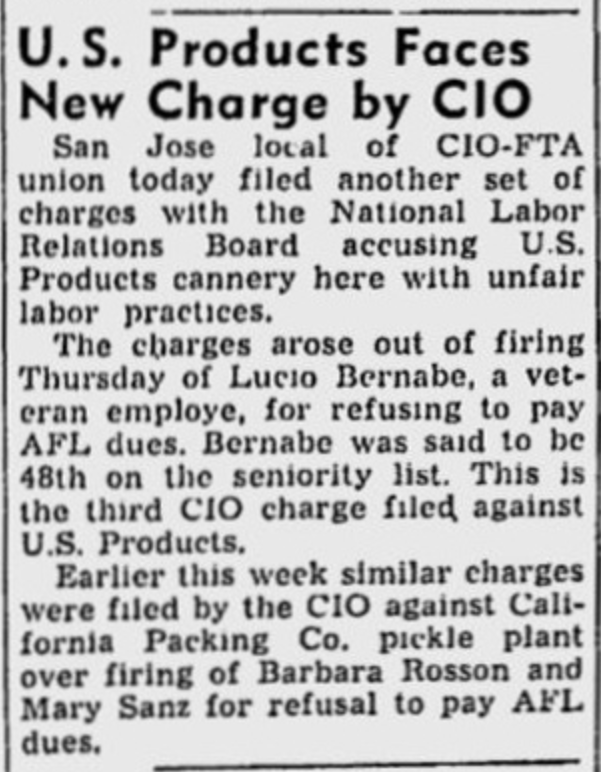
Even though he was 48th on the seniority list, he was fired from the CIO-FTA in 1946, which triggered the union to file a lawsuit with the NLRB against US Products for unfair labor practices. The company alleged that he did not pay AFL dues. After the purging, he joined the International Longshore and Warehouse Union (ILWU) Local 11 and began to organize farmers all over the South Bay and the Central Valley.
In the fifties, Bernabe met Bert Corona, a monumental labor organizer, at a Community Service Organization (CSO) meeting. He informed Corona about the Asociación Nacional México Americana (ANMA); Bernabe formed a chapter in San Jose. It dedicated itself to fighting for Mexican-American rights in factories. It was during this decade that the federal government attacked him and threatened him with deportation. The Immigration and Naturalization Service (INS) performed regular factory sweeps with the intention of deporting undocumented Mexican labor, which also targeted American citizens and documented Mexican immigrants, particularly from the Bracero Program; it was known as Operation Wetback. It was part of President Eisenhower's immigration crackdown.
Organizations all over the Bay Area came to his defense, most notably the American Committee for the Protection of Foreign Born, a mass organization of the Communist Party USA, based in the East Bay, the ILWU and National Lawyers Guild. Thanks to their efforts, they managed to stave off the deportation case. As a result of their victory, the Attorney General named the American Protection of Foreign Born, a “subversive organization.”
During the 1970s, Santa Clara County experienced a wave of anti-immigrant attacks. The Immigration and Naturalization Service (INS) had a policy to remove Mexicans from the country, which was part of Operation Wetback, President Eisenhower’s crackdown on immigration and continued through the seventies. In response to the attacks, Mexican and Chicano groups like the Confederación de La Raza Unida began to organize against the continued INS raids, Bernabe formed the Cannery Worker's Caucus within the Teamsters’ Union Local, and it directly responded to the continued INS sweeps in San Jose; by the 1970s, the INS had deported over 500,000 people. He also fought against discrimination with Teamster contracts, particularly for temporary workers.
Lucio Bernabe died in 2002 in Los Banos.
Throughout his life, he committed himself to organizing workers and fighting for their rights. Although little is known about his life, his story is nonetheless an important one for us to know. Bernabe can give us guidance on the power of community organizing and defense, especially during an era of intense immigration crackdowns.
Comments